






 Career Serve
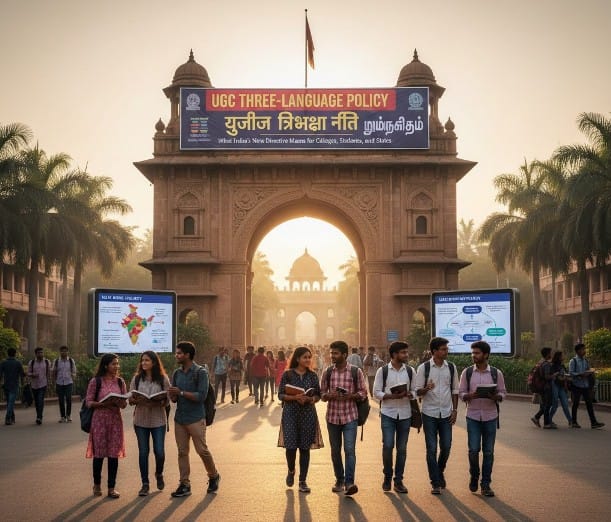
UGC Three-Language Policy: What India’s New Directive Means for Colleges, Students, and States
Introduction: A Transformative Step Toward Multilingual Higher Education
The UGC three-language policy has emerged as one of the most significant developments in India’s higher education landscape. Introduced as part of the broader mission to implement the National Education Policy (NEP) 2020, this directive encourages colleges to expand Indian-language instruction and adopt a more inclusive academic framework.
You can read NEP 2020 guidelines here:
🔗 https://www.education.gov.in/nep-2020
According to the latest communication from the University Grants Commission, institutions must offer at least three Indian language options, ensuring students can learn in a regional language, an additional Indian language, and optionally their own mother tongue. This move aims to strengthen India’s linguistic heritage and promote deeper cultural understanding across campuses.
Official UGC announcements can be found here:
🔗 https://www.ugc.gov.in/
What the UGC Three-Language Policy Includes
The UGC language directive applies to all higher education institutions—state universities, central universities, private universities, affiliated colleges, and technical institutions. Under the policy, students must have access to:
One regional/local language (e.g., Hindi, Tamil, Marathi, Bengali)
One additional Indian language from the 22 scheduled languages
(Full list here: https://www.india.gov.in/official-languages-india)An optional mother tongue or another regional language
These courses can be offered as:
Credit courses
Ability-enhancement courses
Audit/optional courses
To support diverse learner backgrounds, UGC recommends offering these languages at three proficiency levels—basic, intermediate, and advanced.
Alignment With NEP 2020’s Vision for Multilingual Learning
The NEP 2020 multilingual education model emphasizes mother-tongue instruction, regional languages, and the promotion of India’s cultural diversity. By extending this framework to higher education, the UGC aims to:
Enhance cognitive and analytical learning
Encourage students to engage with regional literature
Build inclusive classrooms for rural and semi-urban learners
Foster a national identity rooted in linguistic unity
NEP 2020 explicitly states the need to strengthen Indian languages across all academic stages. Reference:
🔗 https://www.education.gov.in/nep-2020
Multilingual expertise is increasingly valued in fields like public administration, media, teaching, law, translation, and creative industries — sectors where Indian languages hold strong professional relevance.
How Colleges Are Expected to Implement the Framework
To roll out the UGC three-language policy, institutions will need to update academic structures. Colleges may implement the policy in the following ways:
Designing modular language courses with flexible levels
Hiring or training faculty in Indian languages
Using digital platforms for language instruction
Offering hybrid or online classes to cover faculty gaps
Collaborating with regional language boards and universities
Resources for Indian language development:
🔗 https://www.ciil.org/ (Central Institute of Indian Languages)
UGC also allows colleges to adopt blended-learning models, which can reduce the need for large teaching teams and support scalable implementation.
State-Level Concerns and Opposition
The proposal has sparked conversations across India, especially in states that follow established language policies. Tamil Nadu, for example, has strictly followed a two-language policy (Tamil + English) for nearly 60 years. Introducing a third language may conflict with the state’s educational philosophy and political sensitivities.
Other concerns raised by states and academic bodies include:
Availability of qualified Indian-language faculty
Increased administrative and financial responsibilities
Students preferring foreign languages for global career goals
Pressure on students in technical or professional courses
Overlap with existing state-level language rules
Tamil Nadu’s official policy reference:
🔗 http://www.tn.gov.in/
While state concerns are significant, UGC has clarified that students are not required to study an additional Indian language—the policy mandates availability, not compulsory enrollment.
Academic Concerns and Industry Perspectives
Many educators argue that although Indian languages hold cultural value, they may not contribute directly to employability in fields like engineering, computer science, or international business. Students pursuing global opportunities often choose foreign languages such as German, French, Korean, or Japanese.
Foreign language resources (non-competing):
🔗 https://www.goethe.de/ (German)
🔗 https://institute.jp/en/ (Japanese education)
However, Indian languages remain essential for careers in civil services, law, teaching, literature, NGOs, media, journalism, and translation services. The new UGC framework ensures that students who want to build careers rooted in Indian linguistic traditions have access to structured learning pathways.
Benefits of the Three-Language Framework
If implemented effectively, the UGC three-language policy could bring several advantages:
✔ Cultural Reinforcement
Students can connect deeply with Indian literature, history, and local narratives.
✔ Cognitive Development
Multilingual students often show stronger analytical and reasoning skills.
✔ Career Opportunities
Government jobs, civil services, education, translation, media, and regional journalism all require strong Indian-language proficiency.
✔ Inclusivity
Students from rural and semi-urban backgrounds gain a more relatable learning environment.
✔ Academic Flexibility
Optional nature ensures no student is forced into additional academic pressure.
Conclusion: A Policy With Both Promise and Practical Challenges
The UGC three-language policy has the potential to enrich India’s higher education system by making campuses more inclusive, diverse, and culturally grounded. While the proposal has faced resistance from states and educators, the optional learning structure gives students the freedom to choose what works best for them.
As India continues to balance modernization with its linguistic heritage, multilingual education may become one of the most meaningful steps toward creating a future-ready, culturally rooted academic generation.